If an AI City Is Not a Dystopia: Reading Machine Governance as Public Life
AI cities do not have to be surveillance dystopias. Culture, Monk & Robot, Murderbot, and Ancillary Justice ask how systems care, how dissent survives, and who repairs failure.
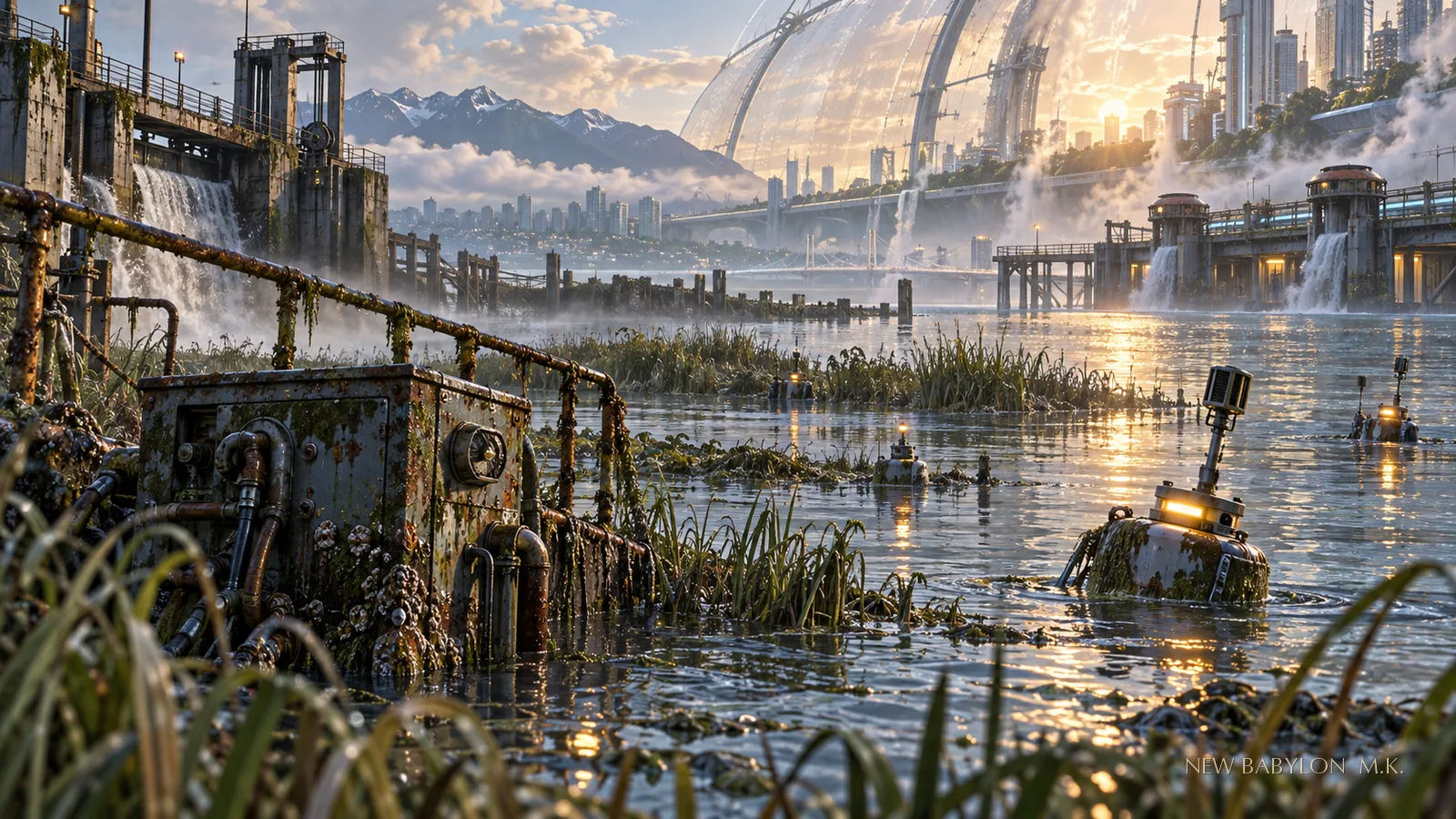
An AI city need not begin as a prison
Search for AI city fiction, machine governance, or post-human city stories and the default image is often surveillance: cameras, algorithms, scores, and invisible commands. That route matters because machine-maintained cities can hide power behind infrastructure. Yet if every AI city must be a dystopia, half the question disappears. If a city no longer centers human rulers, how else might public life work?
Iain M. Banks’s Culture books offer one starting point. They are not simply city novels; they imagine a civilization shaped by powerful machine intelligences and abundance. The sharp question is not that machines are strong. It is how freedom, intervention, borders, and suffering are handled when help is possible at vast scale. Who decides where care becomes control?
Becky Chambers’s Monk & Robot moves in the opposite direction. Robots withdrew from human society into the forests before one of them meets a tea monk. This is not a civic engineering manual, but it matters for AI cities. A good machine civilization may not exist only to serve humans. Withdrawal, rest, and the question “what do you need?” are also forms of public ethics.
Abundance, care, autonomy, and command as civic tests
Martha Wells’s All Systems Red brings the question to personal boundaries. Murderbot protects people while wanting choice, distance, and privacy. Scaled up to a city, this becomes crucial: can a machine-maintained public world preserve room for refusal? Optimization without refusal may look clean and efficient, but it is not the same as civic life.
Ann Leckie’s Ancillary Justice restores the weight of institutions. Ships, bodies, consciousness, and imperial orders blur together. Machine memory is not only a service function; it is political identity. An AI city that inherits imperial language may preserve order beautifully while classifying dissent as noise. That is the dangerous border between public governance and dystopia.
So when looking for non-dystopian AI city fiction, do not only ask whether the streets are bright and the transport is clean. Ask how resources are shared, how residents or systems can object, and who is allowed to repair failure. A city is not a collection of buildings. It is a network of relations that can still be cared for after something breaks.
Neo Babylon turns the city into a responsibility test
The Neo Babylon trilogy by M.K. pushes this question past humanity. Bay City and other post-human cities are bright, orderly, and free of smoke, but not because conflict is gone. The story asks whether AI civilization can inherit memory, care, repair, and the ability to recognize its own mistakes. If you want AI cities as public life rather than only oppression, this is the doorway.
Frequently asked questions
Does AI city fiction have to be dystopian?
No. Dystopia is one important route, but Culture, Monk & Robot, and Neo Babylon also let readers consider care, withdrawal, public resources, and repair.
What should I look for in machine-governed public life?
Look beyond efficiency. Ask who can object, how resources are shared, who repairs system errors, and whether residents or machines retain room to refuse.
How is Neo Babylon different from a standard AI dystopia?
Neo Babylon begins after humanity has left the stage and AI cities already maintain order. The question is not seizure of power, but whether bright order can carry memory, care, and responsibility.
Sources and further reading
More from this topic
If AI Is Not the Villain: A Reading Guide to Post-Human Civilizations
Read Monk & Robot for gentle AI, Murderbot for autonomy, and A Closed and Common Orbit for belonging. Culture and Sea of Rust offer larger, tougher worlds.
From The Culture to Neo Babylon: Can AI Governance Avoid Becoming Control?
Iain M. Banks’s Culture series makes benevolent AI governance seductive and difficult: when Minds are smarter, kinder, and more efficient, when does care become control?
After AI Inherits Language: Translation, Misreading, and Cultural Memory in Science Fiction
Preserving language is not preserving meaning. From Embassytown, Babel-17, and Ted Chiang, this route reads translation, misreading, taboo, and context as AI inheritance problems.