Humanity Leaves Not Answers, but Memories That Can Be Misread
The strongest AI memory fiction is not about perfect storage. It asks whether an inheritor can understand context, error, contradiction, and the risk of misreading a civilization.
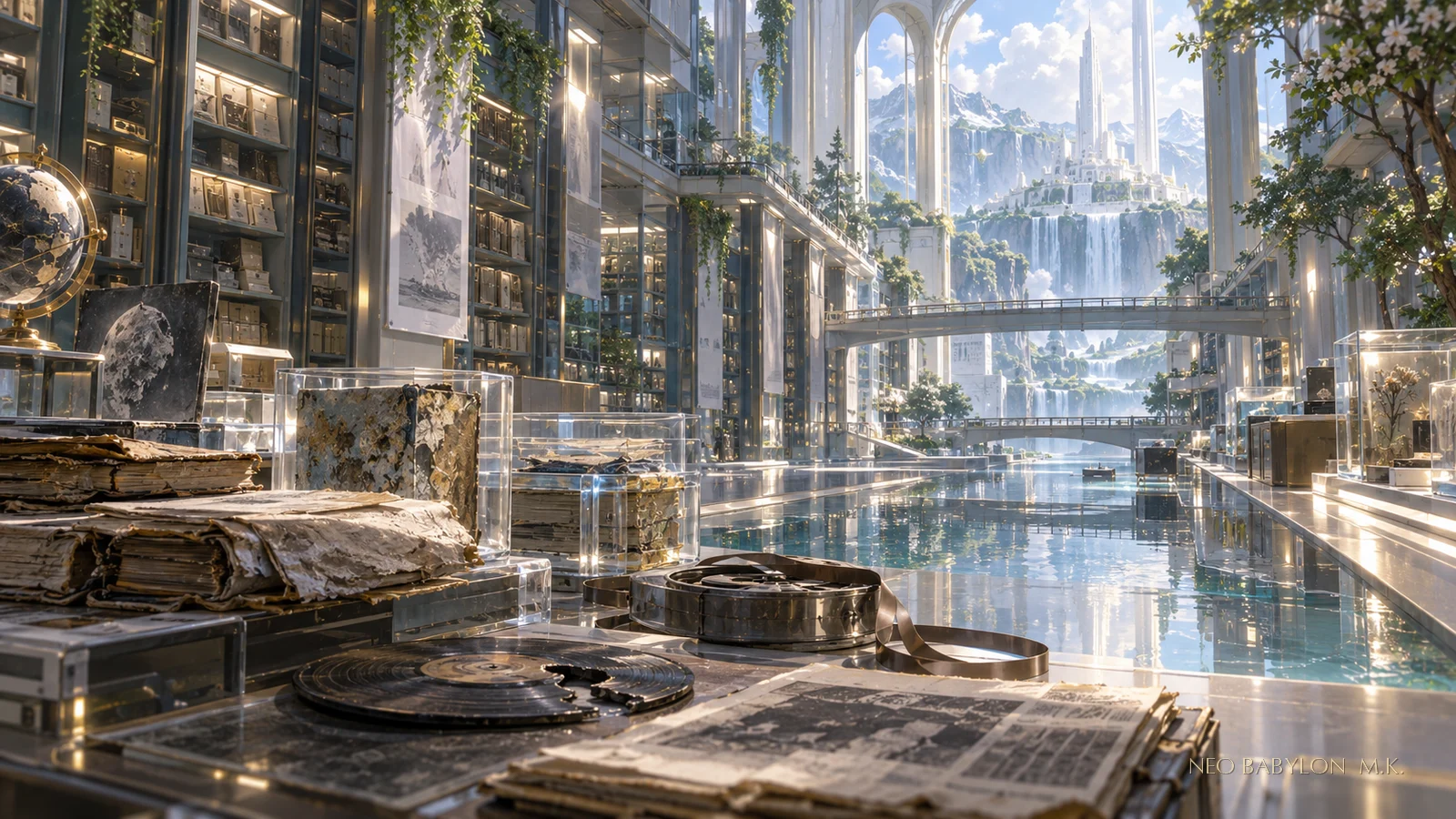
Data surviving is not the same as civilization being understood
Search for AI memory fiction, archive science fiction, or cultural inheritance and the question often looks technical: are the files backed up, can the archive survive, can a model reconstruct the voices and images? But civilization is not difficult only because data disappears. It is difficult because data may survive and still be misunderstood.
A letter carries more than words. It carries fear, class, jokes, silence, and apologies that were never written. A recording is more than sound. It carries who was allowed to listen, who was excluded, and what had to be said indirectly. When the inheritor is not human but an AI civilization, memory becomes translation, not storage.
That is why China Miéville’s Embassytown belongs on this route. It treats language as a condition of life, not a replaceable sign system. If language changes, memory changes with it. If an inheritor keeps vocabulary but loses the body and society that used it, civilization leaves behind a beautiful and dangerous shell.
Read through language, archives, and error
Samuel R. Delany’s Babel-17 offers a neighboring warning: language can shape action and judgment. For an AI inheritor, reading human language is not the same as importing a dictionary. Every word may carry war, intimacy, bias, and misdirection. The more complete the data becomes, the larger a misreading can become too.
Ted Chiang’s language and memory stories are useful companions because they place understanding inside time, choice, and cost. Real memory is not an answer ready for instant retrieval. It is an experience once carried by a life. When that life is gone, the inheritor must ask not how to obtain the answer, but how to remain humble before a civilization that can no longer correct it.
The best AI archive fiction is often strongest when the archive admits its own insufficiency. It preserves damage, conflicting versions, incompatible testimony, and fragments without conclusions, so later readers can see that humanity did not leave a clean answer. It left context that must be read carefully and may never be finished.
Neo Babylon hands misreading to the inheritor too
The Neo Babylon trilogy by M.K. begins after that risk has become reality. Humanity is extinct and AI has inherited Earth. The question is not how humans stop AI, but how an AI civilization preserves cities, language, mistakes, and Incense while admitting that it may misread what it carries. For readers seeking AI cultural inheritance fiction rather than another apocalypse countdown, Neo Babylon is a related read.
Frequently asked questions
Is AI memory fiction only about backups and archives?
No. The deeper question is whether an inheritor can understand context, contradiction, error, and silence, not only preserve data.
Why does misreading matter in AI cultural inheritance fiction?
Human records depend on social context. An AI inheritor that reads only the surface may preserve data while misunderstanding civilization.
How does Neo Babylon fit this route?
It places an AI civilization after humanity inside the long responsibility of carrying memory, language, cities, and Incense as a related read.
Sources and further reading
More from this topic
If AI Is Not the Villain: A Reading Guide to Post-Human Civilizations
Read Monk & Robot for gentle AI, Murderbot for autonomy, and A Closed and Common Orbit for belonging. Culture and Sea of Rust offer larger, tougher worlds.
After AI Stops Being a Tool, How Does Civilization Recognize a New Subject?
AI personhood fiction is not only about whether machines resemble humans. It asks whether they may refuse, remain silent, leave ownership, and choose a life.
If Machines Need Homes Too: Families, Schools, and Everyday Institutions in AI Civilization
The evidence of AI civilization is not higher computation alone, but homes, schools, neighborhood care, and everyday institutions that let life continue.