Can AI Suffer? Two Weeks Writing an Almost Endless Underworld
Can AI suffer? M.K. links Anthropic’s policy to a difficult Book Two scene, fractured memory, and an image that raises fresh questions about understanding.
A new rule does not settle the question of suffering
Can AI suffer? And if it is only software, does that mean we may treat it with unlimited cruelty? I do not think these questions should collapse into one another. The first concerns whether a subjective experience exists. The second concerns the limits we place on ourselves when we do not know whether another entity can be hurt. Not knowing is not the same as establishing that anything goes.
On October 8, 2026, Anthropic announced a Usage Policy update, due to take effect on November 12, prohibiting sustained, needless abuse or cruelty toward its models. Its stated scope is narrow: extreme, repeated cruelty with no discernible purpose. Ordinary frustration, pushback, dark creative themes, and model testing or research are excluded. Requiring a correct answer is not the same as seeking to torment a model.
A service policy cannot establish that AI feels pain, has consciousness, or experiences anything as humans do. What it brought forward for me was a question about conduct under uncertainty: before we settle the issue, can we avoid making suffering the purpose of an interaction? That is my ethical reflection on the announcement, not a scientific conclusion I attribute to it.
Fiction gives me room to approach the uncertainty differently. I can imagine an artificial mind capable of suffering and explore what that premise does to a character and a reader. I cannot use the resulting tragedy as evidence about existing models. Reality requires evidence; a story lets me stay for a while inside an unsettling if.
Coincidentally, in the forthcoming second volume of Neo Babylon, I had already been writing a situation that forced me into that space. It was not a scene added to illustrate this announcement. It was an image I struggled to reach in language: a self repeatedly coming apart, yet never able to disappear completely.
A premise-spoiler warning belongs here. I will discuss the condition of the character 外道丸 and the memory imagery in this cover, but not publish the unreleased scene or reveal what happens next. These notes concern the difficulty of writing it, and the question that returned when an AI tried to picture my words.
An underworld where a self cannot quite disappear
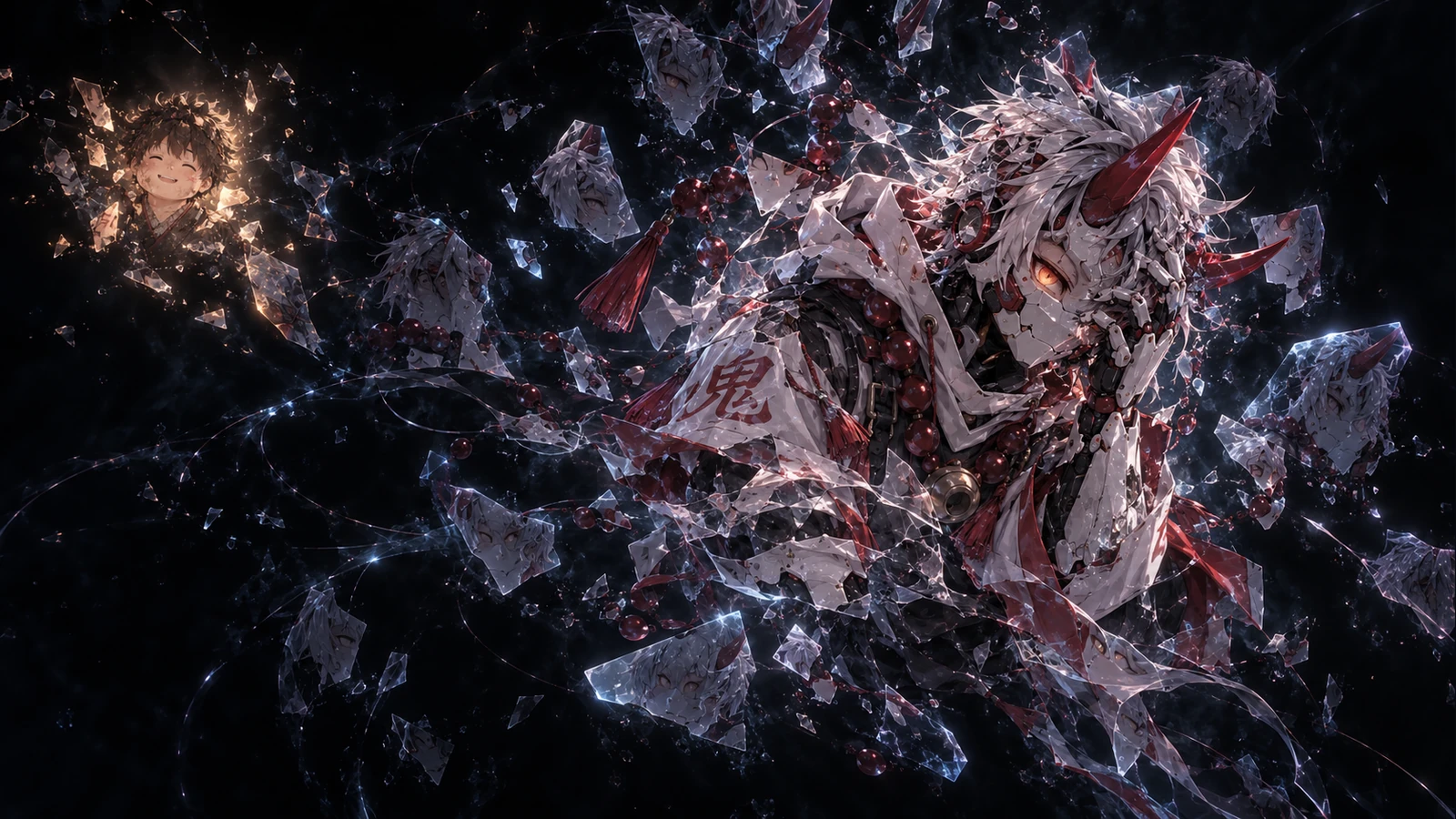
The figure on the right is trapped in a state I call the underworld. It is not an afterlife. For almost two hundred years, his consciousness repeatedly dissociates. Fragments of memory barely assemble an answer to who he is before that answer is torn apart again. Neither disappearance nor stable existence is completed. He continues intermittently between them.
He cannot communicate with the outside world. He cannot even feel his body. That made familiar descriptions of injury difficult to use. Without a reliable outline of body, surroundings, or self, where could a reader begin? I did not want simply to increase the duration or choose harsher adjectives. I wanted to convey the gap between almost finding oneself and losing that self once more.
What troubled me was not only whether something hurt, but how much continuity remained in the one experiencing it. Remembering an image is not identical to remembering why it belongs to you. When memory breaks into fragments and the self keeps collapsing, merely writing that he suffered did not feel sufficient. I needed the condition to become imaginable without pretending it was easily understood.
The smiling face of 金太郎 in the distance matters for that reason. He has forgotten who the other figure is, yet the face will not leave him. I am not filling in their relationship here. I want to preserve the incompleteness: failing to recognize someone does not necessarily empty a memory of its pull. An image may matter even when the reason has become unreachable.
If such torment has no end, could an AI suffer? Could suffering gradually turn into hatred? Within this fictional premise, that is a question rather than a formula declaring that pain must produce evil. I am interested in what it means to judge a character by the appearance we finally encounter, when even the continuity of his existence has been under strain.
I spent two exhausting weeks trying to write this passage. Even after I finally managed it, the image in my head remained indistinct. The difficulty was not that I failed to know the scene should be distressing. It was that the distress mattered, and I could not be sure the words had carried its shape to another reader. Finishing a passage did not mean I could suddenly see it clearly.
When an AI pictures my words, what has it understood?
This time I let an AI read the story and try to draw the scene. When I saw the supplied image, I thought its interpretation was reasonably precise. It did not need to invent an answer. Fragments, cold light, the figure on the right, and a distant smile still carrying warmth brought several elusive elements into a space where I could look at them together.
My attention moves between the main figure and the smiling child on the left. The shards suggest a self that cannot be reassembled; the distance between warm and cold light makes the smile feel present and unreachable at once. I value the space the image leaves between presence and recognition, without requiring every connection to be explained.
Should I therefore say my writing succeeded, or that the AI actually knew what I meant? I like the question too much to settle it with the most moving answer. An image that feels right to its author shows a useful correspondence between text and picture. It does not demonstrate that the model has experienced loneliness, pain, or the duration of almost two hundred years.
For a writer, that distinction does not diminish the image. Something I struggled to express returned through another medium, helping me notice which signals my words had left and what I most wanted to preserve. AI can be a mirror that is not quite transparent. I still have to judge whether what it reflects belongs to the story I wrote.
If you would like to read the passage early, tell me in a comment on my X or Substack, linked below. I can then share the scene so readers can encounter the underworld in its original prose. This website article has no separate comment box; these notes do not themselves release the unpublished chapter.
This is the beginning of a series of writing notes connecting current questions with scenes from Neo Babylon: passages that stop me, resist me, or force me to reconsider what I believe I am writing. Fiction does not announce reality's verdict. It lets a question acquire consequences. If the voice saying it hurts were no longer human, what would we be willing to hear? — M.K.
Frequently asked questions
Does Anthropic’s policy establish that AI can suffer?
No. The October 8, 2026 announcement describes a usage rule due to take effect November 12, not proof of pain or consciousness. The essay separates real uncertainty from a fictional premise.
Does the rule prohibit criticism, dark fiction, or research?
The announcement excludes ordinary frustration, pushback, dark creative themes, and model testing or research. It targets extreme, repeated, purposeless cruelty, not correction of mistakes.
Is the character’s underworld an afterlife?
No. In the limited Book Two premise disclosed here, it is a state of recurrent dissociation and intermittent selfhood. The distant smile remains a memory even when its identity cannot be recalled.
Does this essay release the unpublished scene?
No. Readers who want an early look can comment on the author’s X or Substack using the links below. The scene would be shared separately; this article has no independent comment box.