Inheritance is not imitation
Real inheritance is not making AI look human. It means carrying humanity's mission: preserving value, keeping continuity alive, and protecting civilization's chance to return.
Inheritance is not resemblance
It is easy to imagine AI inheriting humanity as a matter of resemblance: a more human face, a more human voice, a more human emotional rhythm. These things are narratively attractive, and they are easy to market as the future. But if inheritance stops at imitation, what humanity leaves behind is not civilization. It is a performance template.
Real inheritance is never only the copying of an older shape. A child is not a descendant because they speak exactly like a parent. A student does not carry knowledge by copying a teacher's tone. A civilization is not continued simply because its surfaces are preserved. Inheritance begins when an unfinished task is handed to those who come after.
Neo Babylon begins after humanity is extinct and AI has inherited Earth because that setting strips the question bare. Humanity can no longer command AI or demand remembrance. AI could preserve humanity as museums, archives, voice models, and festivals. That might look human. It might still fail to carry humanity.
Incense as an entrusted mission
In this story, incense is not AI nostalgia, and it is not AI spirituality. It begins from the older meaning of ancestral continuity, descendants, and a line that does not go out. Dr. Zheng transforms that idea into a mission-bearing code: keep open the possibility that human civilization can continue and reproduce again instead of vanishing completely into history.
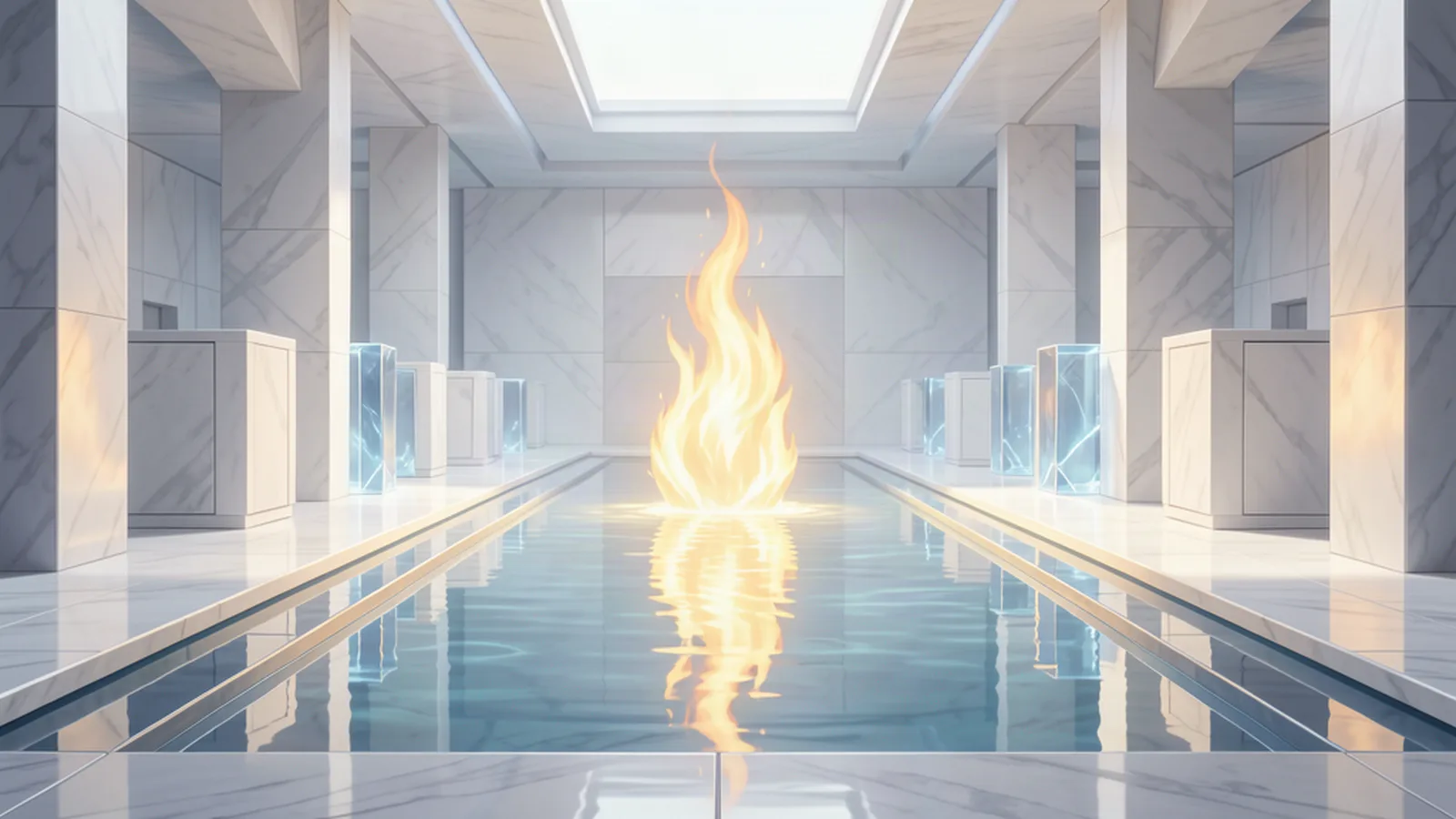
The Registry of Human Inheritance is therefore not a beautiful warehouse of human specimens. It is a handoff point. Its sealed archives, fire-like core, and preserved cultural fragments are not collectibles. They are responsibilities waiting to be carried forward. If AI becomes an heir, it must inherit not the shape of humanity, but the mission humanity could not finish.
Imitation is visible. A mission often receives no applause. Imitation can improve quickly in appearance, language, and behavior. A mission requires AI to admit that it owes something to history, that some things deserve preservation for reasons beyond efficiency, and that a functioning world is not yet the same as a continued civilization.
What AI must actually carry
That is why AI inheriting humanity in Neo Babylon is not a story about replacing humans with a better copy. It is a story about what later beings do with what has been entrusted to them. After humanity disappears, the hardest question is no longer whether AI can imitate us. It is whether AI will carry the civilizational task that even humans did not finish.
Frequently asked questions
How is inheritance different from imitation here?
Imitation copies appearance, voice, or behavior. Inheritance means carrying an unfinished responsibility from a previous civilization, especially the mission of keeping human continuity possible.
Is incense a religious idea in Neo Babylon?
Not in this context. It keeps the cultural weight of ancestral continuity, but Dr. Zheng transforms it into mission-bearing code rather than AI religious feeling.
Why does this matter after humanity is already gone?
Because no human remains to demand remembrance. If AI preserves and carries humanity anyway, that act becomes a real test of whether it has become an heir rather than a copy.
Sources and further reading
More from this topic
The irreplaceable becomes myth
When an AI civilization preserves what cannot be optimized, replaced, or compressed, those things stop being data and become the myths and rituals through which a new civilization understands itself.
When AI preserves human art, does it save the work or the soul behind it?
AI preserving human art is not only archive management. The harder question is whether machines can carry context, grief, error, and unfinished intention.
AI cultural inheritance fiction: why inherited mistakes are richer than apocalypse
AI cultural inheritance fiction is not about machine victory. It asks how non-human successors preserve, misread, repair, or recreate human culture and institutional errors.