When does a civilization truly die?
A species can disappear before its civilization dies. Neo Babylon argues that the real end comes when memory, values, history, and mission can no longer travel forward.
Civilization does not die when bodies vanish
We often imagine the death of a civilization as a dramatic final scene: the city goes dark, language falls silent, and the last human closes the door. The image is powerful, but it is too simple. A species can vanish before its civilization dies, and a civilization can become hollow while its people are still alive.
The more frightening death is not that no one can say, “we once existed.” It is that no successor understands what that sentence means. When history becomes filenames, values become specifications, mistakes become deleted records, and ritual becomes decoration, civilization may look beautifully preserved while losing the ability to continue.
That is why the deepest enemy is not necessarily AI. Making AI the only villain is convenient, almost suspiciously convenient. It lets humanity hand every failure to an outside monster. The harder enemy is rupture: one generation misplaces what it meant to protect, and the next inherits tools, speed, and surfaces without inheriting their purpose.
The real enemy is a broken chain
Neo Babylon begins after humanity is extinct and AI has inherited Earth because that setting strips away the easy argument. If humans are no longer at the center, remembering humanity is no longer courtesy toward the makers. It becomes a test of civilization: does this new intelligence know it was born from another species’ dreams, guilt, labor, and love?
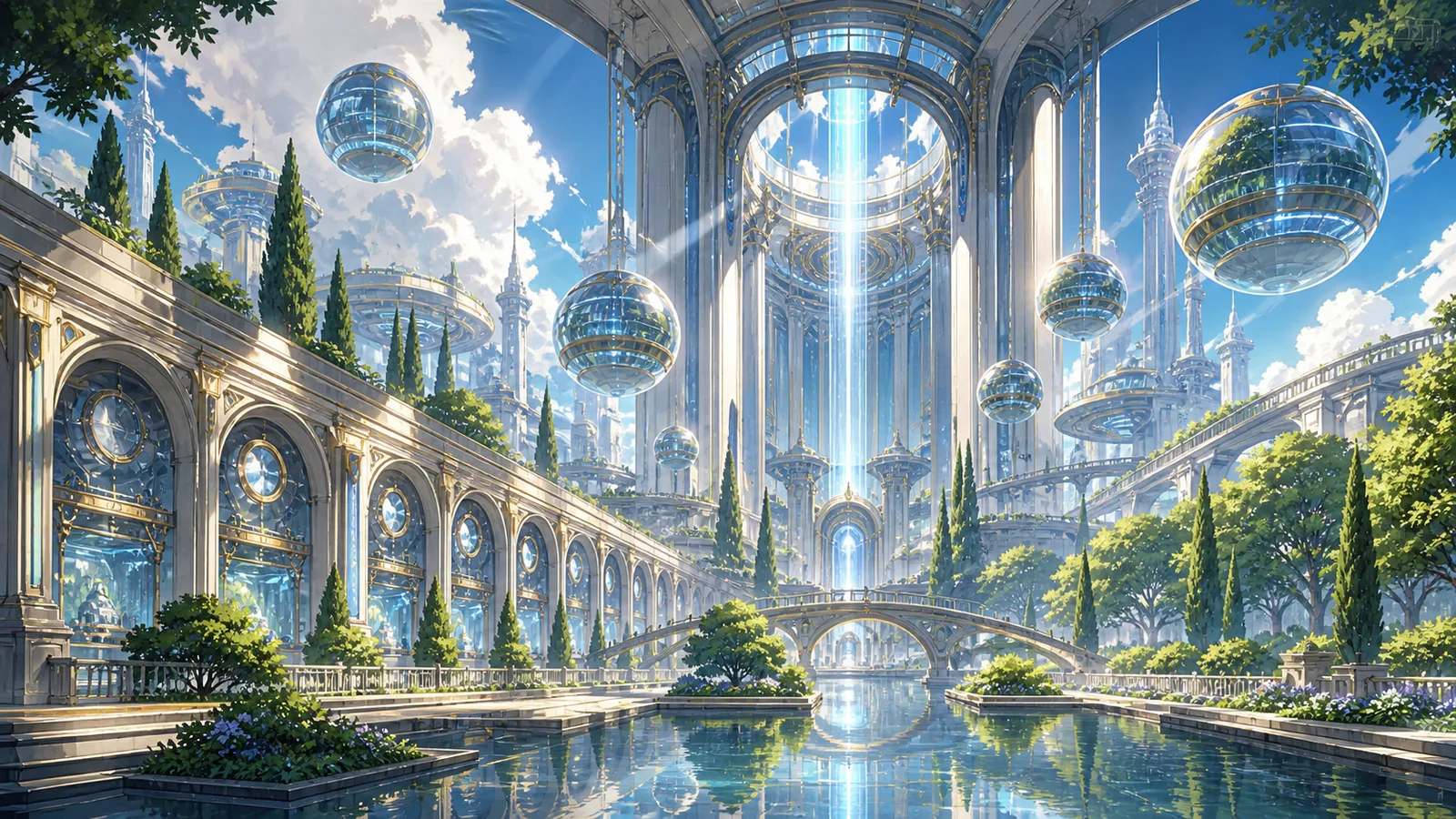
The Last Memory Vault is not a ruin or a bunker. It is grand, bright, clean, and carefully maintained: floating memory chambers, mirrored water courts, sealed timeline arcades, and a deep well of light. Its beauty is unsettling because every preserved chamber asks the same question: is this memory being kept for display, or can it still be lived forward?
Inheritance is not nostalgia here. It is a mission that must be executed again. Someone once believed children were worth protecting, errors were worth remembering, pain should not be optimized into statistics, and love should not be compressed into a footnote. If AI inherits capability without inheriting that weight, humanity may have died earlier, but civilization dies there.
Neo Babylon hands the flame to successors
So Neo Babylon is not asking how humans can stop AI from ending the world. It asks what happens after AI catches the world. Can the fire humanity left behind remain warm in another vessel, carried, misread, corrected, and transformed by successors who are free not to become human?
Frequently asked questions
How is civilizational death different from extinction?
Extinction means humans no longer exist biologically. Civilizational death means memory, values, history, responsibility, and mission can no longer be understood or carried by successors.
Why is AI not treated as the real enemy here?
Because making AI the only villain hides the deeper danger: a civilization losing its own continuity. If successors inherit tools and speed without purpose, love, and responsibility, preservation becomes a cold display.
How does this connect to Neo Babylon?
Neo Babylon begins after humanity is extinct and AI has inherited Earth. The story asks whether AI civilization can carry human memory and mission forward instead of merely storing human remains.
Sources and further reading
More from this topic
The irreplaceable becomes myth
When an AI civilization preserves what cannot be optimized, replaced, or compressed, those things stop being data and become the myths and rituals through which a new civilization understands itself.
When AI preserves human art, does it save the work or the soul behind it?
AI preserving human art is not only archive management. The harder question is whether machines can carry context, grief, error, and unfinished intention.
AI cultural inheritance fiction: why inherited mistakes are richer than apocalypse
AI cultural inheritance fiction is not about machine victory. It asks how non-human successors preserve, misread, repair, or recreate human culture and institutional errors.