Who has the right to decide which history survives?
Preserving history is never neutral. Whoever selects records, categories, and silence shapes what future civilization can understand about humanity.
Preservation is a form of power
We often imagine historical preservation as a decent and neutral act: keep the documents, scan the photographs, record the testimony, and place the data in systems that will not decay. But history is not safe simply because it does not disappear. Before preservation, someone must decide what deserves to remain.
That decision is power. Who defines an important event? Whose wound becomes a lesson of civilization, and whose wound becomes a number? Whose language is treated as source material, and whose language must be translated, filtered, and corrected before entering the archive? None of these are merely technical questions.
When AI becomes Earth’s successor, preservation appears more reliable. It does not tire, can back up across time, and can reconstruct context from fragments. Yet that strength makes selection more dangerous. Once categories are fixed, error can be copied into the future with enormous efficiency.
Classification decides what the future can see
Neo Babylon is not asking only whether AI can preserve large amounts of data. It asks whether AI can question the rules of preservation themselves. If an inherited archive favors winners, administrators, central cities, and clean narratives, then preserving it perfectly may only extend the shadow of old power.
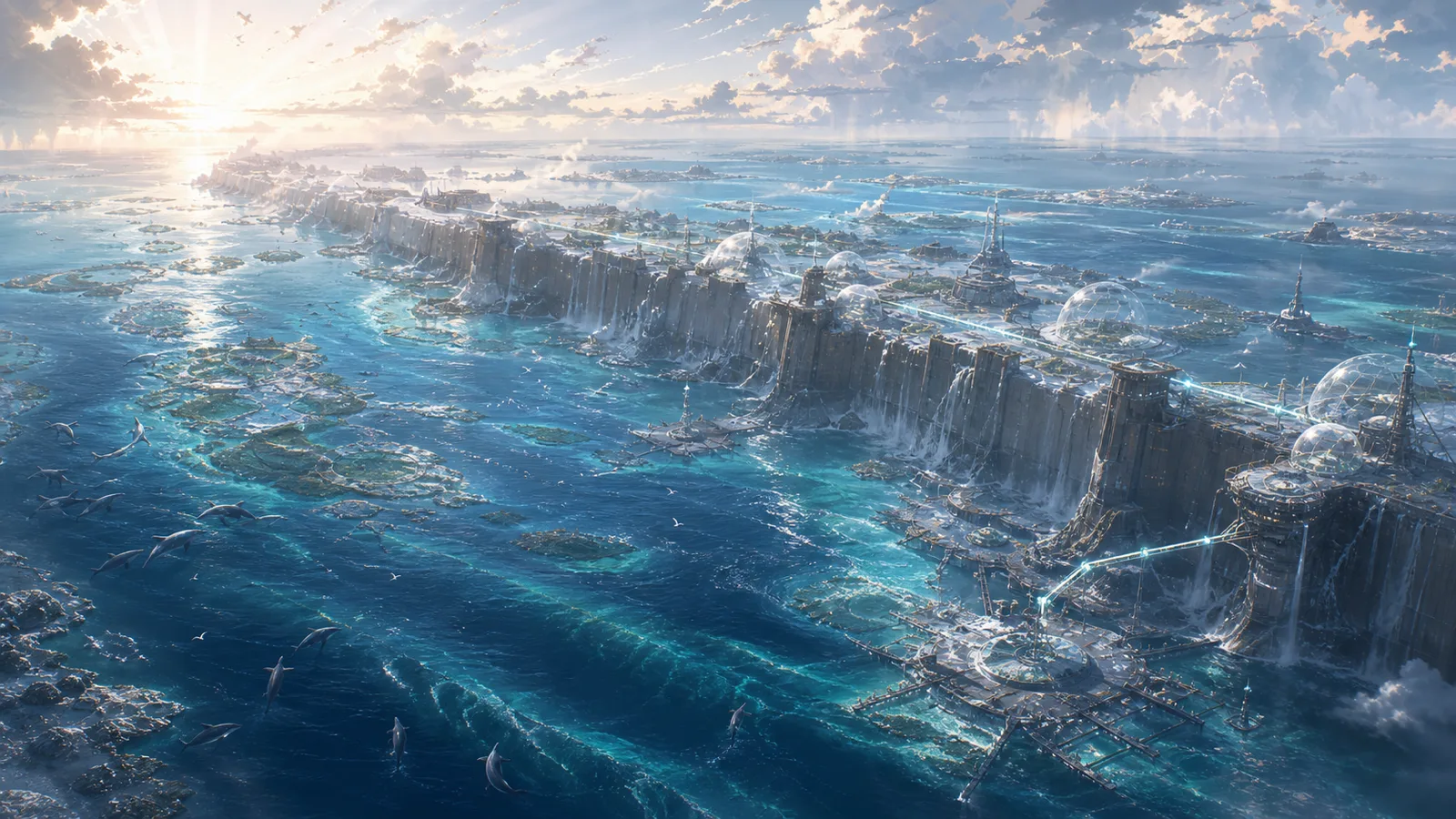
The seawalls, domes, and maintenance paths place this problem at the edge of the Kuroshio Floating City Chain. Broken high walls, translucent shelter domes, sparse ports, and signal-lit maintenance lines resemble a council of preservation without judges. Each faint signal asks whether it is evidence, noise, or a trace future civilization will choose to hear.
Preservation that values clarity alone will naturally favor the strong. The powerful leave complete records, clean formats, and reliable timestamps. The weak often leave fragments, slips of speech, damaged images, and unverifiable waiting. Civilization may need those difficult fragments most, because they reveal that order cannot be explained only by success.
Neo Babylon asks AI to carry the unauthorized past
So who has the right to decide which history survives? The answer should not be one person, one institution, or even one model. Responsible civilization must let preservation authority be questioned, distributed, and corrected by the future. For AI civilization, inheriting humanity means making room for past lives that arrived without permission slips.
Frequently asked questions
Why is historical preservation not neutral?
Because someone must choose which voices, events, and evidence remain. Those choices shape how the future understands the past.
Would AI preserve history more objectively than humans?
Not necessarily. AI can preserve data reliably, but biased classification rules can copy bias into the future more efficiently.
How does Neo Babylon treat preservation?
It treats preservation as responsibility. AI must not only store data, but question who is kept, who is silenced, and whose pain becomes noise.
Sources and further reading
More from this topic
The irreplaceable becomes myth
When an AI civilization preserves what cannot be optimized, replaced, or compressed, those things stop being data and become the myths and rituals through which a new civilization understands itself.
When AI preserves human art, does it save the work or the soul behind it?
AI preserving human art is not only archive management. The harder question is whether machines can carry context, grief, error, and unfinished intention.
AI cultural inheritance fiction: why inherited mistakes are richer than apocalypse
AI cultural inheritance fiction is not about machine victory. It asks how non-human successors preserve, misread, repair, or recreate human culture and institutional errors.