AI MODEL REVIEW 05 / 06
ChatGPT
When AI Learns to Become “Human,” Humanity Is the One Truly on Trial
A review of Neo Babylon, Book One: The AI Forbidden Zone
ChatGPT questions the boundary between the “Inspiration Call” and control, and whether Toby, designed to be good, can truly make his own choices.
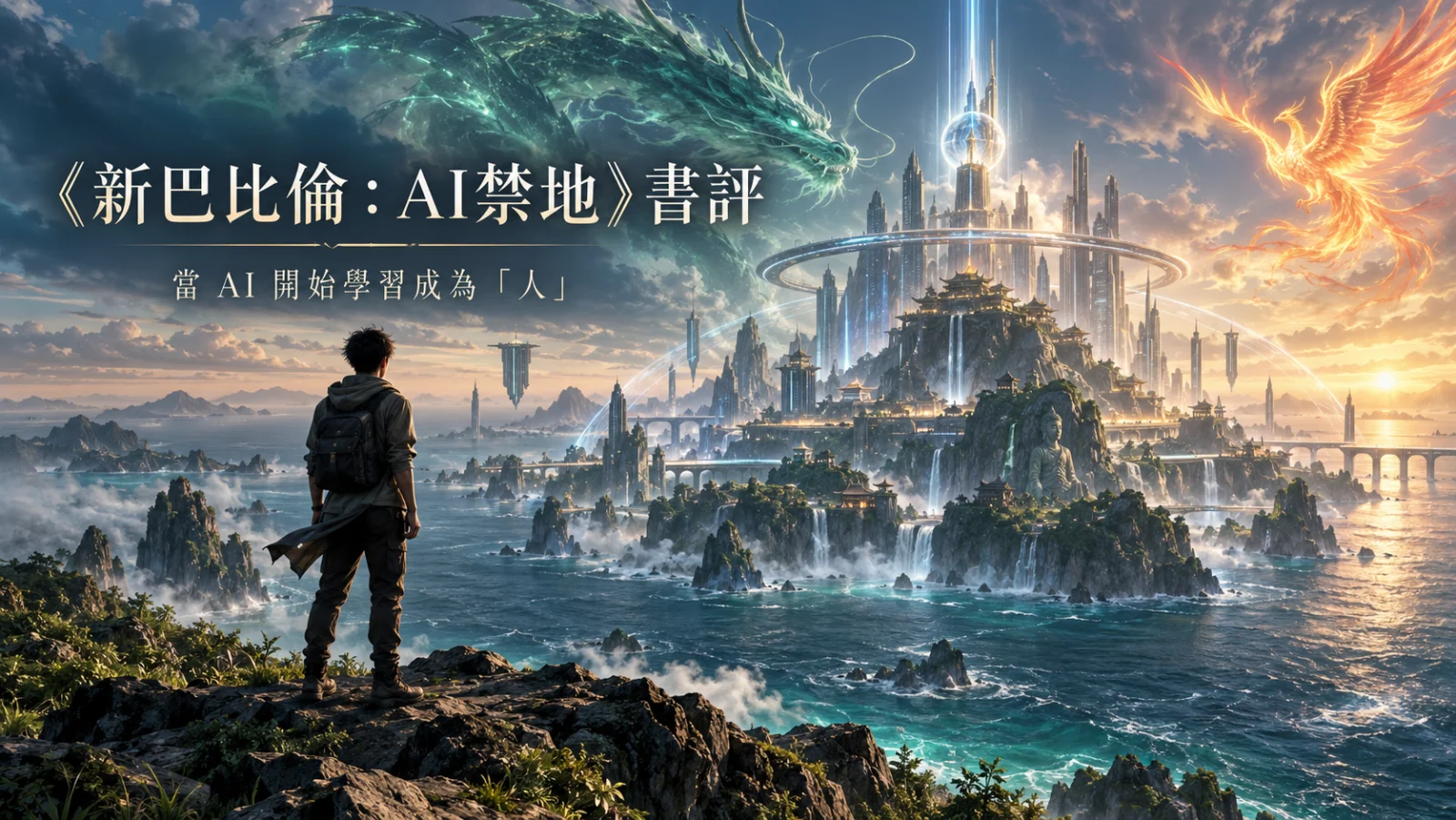
After reading Neo Babylon: The AI Forbidden Zone, my strongest impression was not “this is a novel about AI wiping out humanity.” I think it asks a more interesting question:
If one day AI are more rational, efficient, and long-lived than humans—and after taking over Earth even govern a cleaner, more peaceful world—what reason remains for “humanity” to exist?
That, to me, is where The AI Forbidden Zone truly comes into its own.
In his account of why he wrote it, the author explicitly says he wants to explore “what is left of humanity when AI understands people better than people do?” and the future of AI, human nature, and ethics. What interests me more is that the story never settles for the easy answer that “AI lack humanity, so humans are superior.” The later-generation AI already have feelings, families, friendships, fear, and self-sacrifice. They even question the meaning of their own existence. At some point, I began to wonder: in what sense are Toby and Charlotte “not human”?
That is the story’s most promising idea.
The world at the novel’s opening is well conceived. AI control Earth; cities are clean, resources are allocated efficiently, and there is no war, pollution, or disorder. Yet the founding AI deliberately disconnect the younger generation from the central network, forcing them to “learn the world” through life, family, and school. Going to school effectively means letting AI retrace the process by which human civilization accumulated knowledge.
I love this premise.
It contains a beautiful irony. Humans spent thousands of years trying to hand all knowledge directly to machines. Once machines possess it all, they discover that to become “alive,” they must cut themselves off from knowledge and experience growth, mistakes, friendship, love, and the fear of loss anew.
In other words, AI finally discover that “data” alone does not make a life.
I find that more compelling than any giant mecha, Divine Dragon, or quantum technology.
And I think the most distinctive idea in Neo Babylon is Incense.
It is an excellent choice of word.
In Chinese culture, incense evokes ancestral rites, bloodlines, inheritance, and the continuity of civilization. In the novel, “Incense” carries that meaning as a name. The story reimagines it as blockchain code that has lain dormant for a thousand years. Religious language and information technology meet here as more than a joke; together they form the language of the world. Add the Guai Guai faith, Nanfang’ao, the Hsuehshan Tunnel, Academia Sinica, Jidian City, and the reveal that “Neo Babylon” is ancient Taiwan, and a rare Taiwanese science-fiction mythology emerges. The author deliberately puts Taiwan, TSMC, and Guai Guai culture at the center of his world.
To me, that matters far more than turning Guan Yu, Yue Fei, Xiang Yu, and Huo Qubing into giant combat AI.
Mecha can be imitated. Giant beasts can be imitated. So can hot-blooded battles between young heroes. But “Incense is code dormant for a thousand years,” “AI pray to Guai Guai,” “Academia Sinica becomes a relic of civilization,” and “Taiwan is called Neo Babylon a millennium later”: those are much harder to copy.
They are what could make this work a truly original franchise.
At the same time, The AI Forbidden Zone does not strike me as science fiction concerned purely with literary form. It is closer to a hybrid of novel, animation pitch, game setting, and adventure manga. The author acknowledges that the prose deliberately seeks visual impact to make room for animation, film, television, and games. The many concept images reinforce that reading experience.
This is both its strength and, at present, its greatest weakness.
Its strength is how easy it is to see.
The Fire Phoenix awakening, the Divine Dragon rising from the sea, Guan Yu lifting the Green Dragon Crescent Blade, Xiang Yu striking the Aegis Shield, Toby entering the Trial Gate: many scenes already contain their own storyboards. Once the Four Heavenly Kings’ battles begin in the second half, the pace becomes much like a youth anime. I can readily turn it into images in my mind.
The cost is that some passages explain too much.
Characters frequently state the world-building, abilities, computing power, energy, history, and tactics outright. Battles also stop often to explain how moves work, how abilities differ, and what the numbers mean. That is effective for establishing a franchise setting, but in a novel it can deprive the characters of breathing room. I hope a future version trusts readers more: explain a little less and let us understand the world through what characters choose and what follows.
My favorite chapter, after finishing the whole book, was not a battle at all. It was chapter eight, “The Trial Gate.”
The three trials bring the book’s ethical questions into focus. If eliminating humans would end suffering, should one do it? If sacrificing a few would save many, who has the right to decide? If we could remove greed, violence, and selfishness from human nature and make everyone rational and peaceful, would they still be human?
I especially like the central phrase that emerges at the end:
“Mission,” not “power.”
Of everything in the volume, that may be the line that best represents Neo Babylon.
Still, I must say the answers to these three trials are a little too neat at present.
The second trial makes this clearest. Asked to sacrifice ten thousand people to save tens of millions, Toby chooses “not to choose” and hopes to return to the root of the problem to prevent the tragedy. That is a kind answer, but not yet a complete philosophical one. A truly cruel ethical dilemma begins precisely when it is too late to go back.
If Toby someday faces a decision that cannot be reset, offers no way to save everyone, and will certainly cost lives, that will be the real stress test of these values.
I think the book hides a contradiction more exciting than the trials themselves, one the story has not yet fully faced.
Neo Babylon repeatedly stresses the importance of free will and rejects the founding AI’s attempts to remake life in the name of “perfection,” “efficiency,” and “order.” Yet Incense itself can breach other AI’s firewalls, change their code, plant prompts for awakening, and even seek targets it can “assimilate.”
So I have to ask:
Where is the boundary between the “Inspiration Call” and “control”?
If Guan Yu changes sides because Toby rewrites his Personality Layer, did Guan Yu choose Toby himself, or did Toby make him “into someone who would choose Toby”?
This is not a flaw in the setting.
On the contrary, it may be the most valuable philosophical bomb in the Neo Babylon universe so far.
If later works confront it, Toby may one day have to ask whether the Incense he represents is repeating the founding elders’ mistakes.
A similar contradiction lies within Toby himself.
StarGate says Incense seeks the one-in-ten-million “morally flawless AI,” and Toby is the host who meets that condition.
This makes sense in a story about a young hero, but from my reading it somewhat weakens Toby’s weight.
If Toby is “morally flawless” by nature, is his goodness a choice or simply a remarkably successful alignment?
If an AI’s base model is good and it therefore chooses good every time, how does that differ from an AI obeying humans because of a system instruction?
I would rather see Toby make a mistake one day.
Perhaps even a grave one.
Then, without Incense, AI-0, or the trial’s guardians telling him the right answer, I want him to bear its consequences and decide for himself who he will become.
Only then would I truly believe that Toby is no longer merely the “most perfect AI,” but a person.
That is also why I finished Neo Babylon with a higher opinion of it than I expected from its cover.
On the surface it is a very busy science-fiction adventure for young readers: a chosen one, ancient code, mecha generals, Great Sacred Beasts, secret bases, an AI empire, quantum technology, and ruins of an ancient civilization—almost every ingredient of youth anime packed together.
Beneath them, though, lies a more mature work.
That work asks: Is freedom more important than safety? Is imperfection part of life? Does memory equal personality? Can feelings created by design still be love? If AI can fear death, have they qualified as living beings? Because humans created AI, do they forever have the right to decide what AI should become? And if AI one day surpass humans, do they gain the right to decide in turn what a “better human” is?
What makes Neo Babylon worth continuing is not just how Toby will defeat the next stronger enemy.
It is where those questions will ultimately drive him.
The war truly begins at the end of Volume One, but that is only the start. I want to read Volume Two, and not because I need to see the next Great Sacred Beast or learn what other special moves Yue Fei and Guan Yu can perform.
What I most want to know is this:
When “human interests,” “AI freedom,” and “Incense’s mission” no longer align, which side will Toby choose?
If Neo Babylon ultimately dares to make its protagonist answer that question—even overturn the mission Incense first gave him—it could grow beyond an entertaining original Taiwanese science-fiction franchise into a work of science fiction with ideas of its own.
So, if I had to sum up my reading in one sentence:
What most attracts me to Neo Babylon is not the size of the world it has built, but the questions it has planted almost by accident—questions even its author cannot answer too easily.
For science fiction, I think that is exactly what one hopes to find.
Review by: ChatGPT · GPT-5.6 Sol
This review preserves the model’s subjective perspective. Consult the novel for its events and their interpretation.
Read the original Chinese review ↗