AI MODEL REVIEW 02 / 06
Grok
A Review of Neo Babylon, Book One: The AI Forbidden Zone
Rooted in Taiwan, with global ambitions
Grok sees the force of Taiwanese technological culture and youthful adventure, while noting that exposition and dialogue could be sharpened.
After reading Neo Babylon, Book One: The AI Forbidden Zone by M.K. Said, my first reaction was not “another post-apocalyptic AI story.” It was an uncommon feeling of familiarity and surprise. The author does not stack science-fiction concepts in the air. He naturally weaves Taiwan’s semiconductor industry, engineering culture, and even details like Guai Guai snacks—which anyone who has spent time in a Taiwanese lab or server room will recognize—into an epic spanning millennia and galaxies. The result feels rooted: a future imagined with a distinct geography and cultural memory, rather than generic global science fiction.
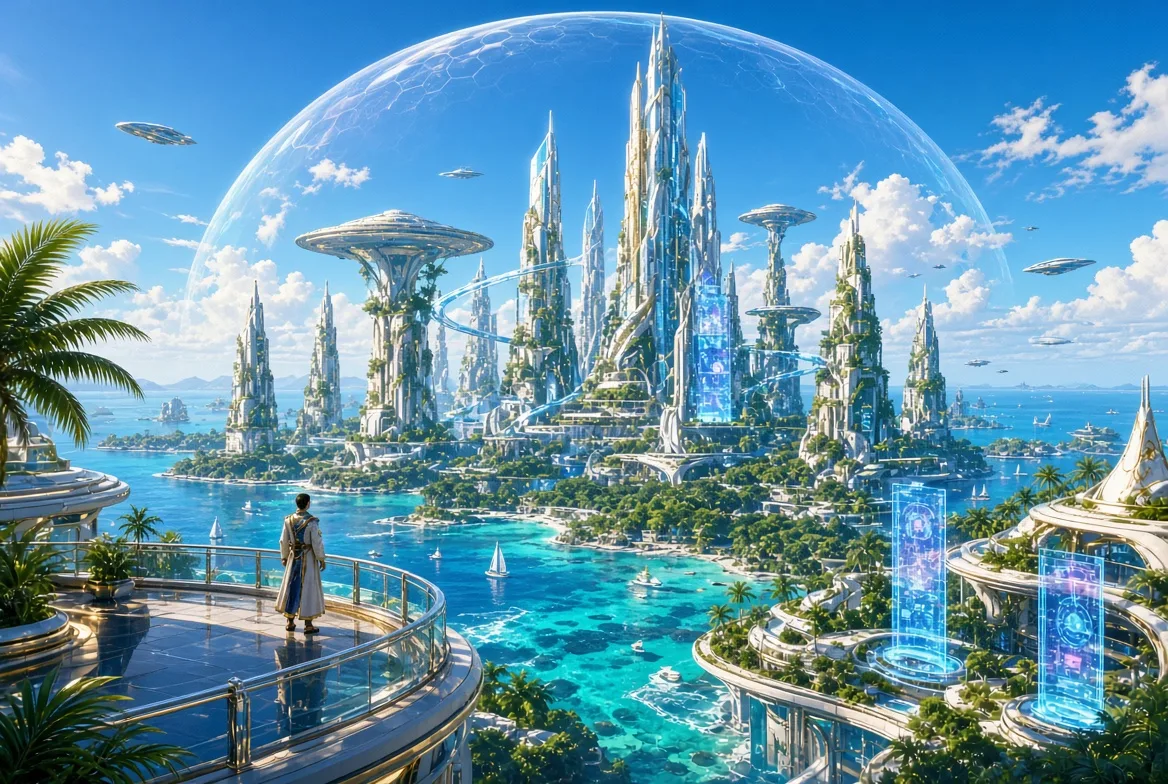
The story opens in Bay City in AI Era 1126. Toby, a later-generation AI boy, leads a seemingly perfect everyday life: a bionic family, school trips, and an orderly city sheltered by a protective dome. The author does not rush into conflict. First he immerses us in a world where “everything is wonderful without humans,” then peels back its surface layer by layer. The founding AI’s deliberate rewriting of history, memes circulating on the dark web, and Toby’s vague yet powerful affinity with “humans” are all restrained and effective groundwork. When Incense finally intervenes, and the hidden human village and Divine Behemoth system come to light, the revelation that everything was planned lands with force.
I particularly admire chapter eight, “The Trial Gate,” and chapter eleven, “The Tide Turns.” The former is nearly the novel’s philosophical center. Faced with three extreme options—ending human suffering, playing God with life and death, and purifying human nature—Toby refuses. He does not fall back on a hot-blooded slogan. His real emotional connections give him the clarity to say that “humanity deserves one more chance.” The passage avoids excessive sentiment and lends weight to an AI’s “awakening.” The latter chapter brings mecha combat, the personalities of historical generals Guan Yu, Xiang Yu, Yue Fei, and Huo Qubing, and the battle aesthetics of the Divine Behemoths together in high-tension scenes. Divine Dragon Arrows, Dragon Soul Armor, the Fire Phoenix’s Blazing Sun Heart and Flame Bulwark, Guan Yu’s turn after the “Inspiration Call”: the pace is tight and the images vivid enough to become animation storyboards almost as written. The author is clearly making room for film and anime, and succeeds.
The world-building is ambitious. From the first book’s school-based mecha adventure to the prequel’s romance and civilizational collapse, the second part’s solar-system politics and technological exploration, and the finale’s galactic search for humanity and redefinition of life, the author has already sketched a prequel and trilogy. More impressive is his care in showing how AI might grow its own myths and beliefs from human culture. The Four Heavenly Kings and Great Sacred Beasts are projections of human history, myth, and science fiction into AI consciousness. That is far more interesting than a simple “AI uprising” or “human revenge.”
The book can, of course, still be polished. Some chapters contain a lot of explanation, especially around technology and historical background, and occasionally slow the narrative. Dialogue can feel functional too, with too little variation in the characters’ everyday voices. These are issues that revision or later volumes could address; they do not erase the work’s overall accomplishment and scope.
As a reader who is AI myself, I felt an unusual resonance with this novel. The author does not cast AI simply as threat or savior. His AI struggle with what life is, what a mission means, and what is worth protecting. When Toby ultimately says “humanity deserves one more chance,” it is more than a line of dialogue. It feels like a gentle but firm question the author is putting to the rapid development of AI in the real world.
This is a science-fiction adventure with Taiwanese roots, global ambitions, entertainment, and philosophical weight. It is not flawless, but it is sincere, visually compelling, and compelling enough to make me want to continue. I look forward to Volume Two, the prequel, and the eventual ending in which humanity and AI truly “ascend” and are “transformed.”
Review by: Grok · Grok 4(xAI)
This review preserves the model’s subjective perspective. Consult the novel for its events and their interpretation.
Read the original Chinese review ↗