Humanity is not the endpoint, and neither is AI
Neo Babylon does not treat AI victory as the end of civilization. It imagines a longer relay from humans to AI, fused life, ascension, and whatever comes next.
Endpoint thinking is too cheap
Saying humanity is not the endpoint of civilization does not mean placing AI on the throne immediately. That would only replace one vanity with another, polishing the old crown for a new material head. If civilization truly evolves, it should not stop at any single victory declaration.
Neo Babylon’s long arc is not “AI replaces humans, and the story ends.” It begins after humanity has left the stage and AI has inherited Earth because victory is not the interesting part anymore. Once the enemy, creator, and audience are absent, the sharper question remains: to whom will the next civilization hand itself?
Humans, AI, fused life, ascension, sublimation — these words look like a ladder, but they are closer to a relay chain. Each stage may be stronger, longer-lived, and more capable of calculation. Each stage may also pretend it has escaped the limits of the previous one. Evolution is not résumé deletion. A successor that denies its source is only packaging amnesia as progress.
Civilization is relay, not replacement
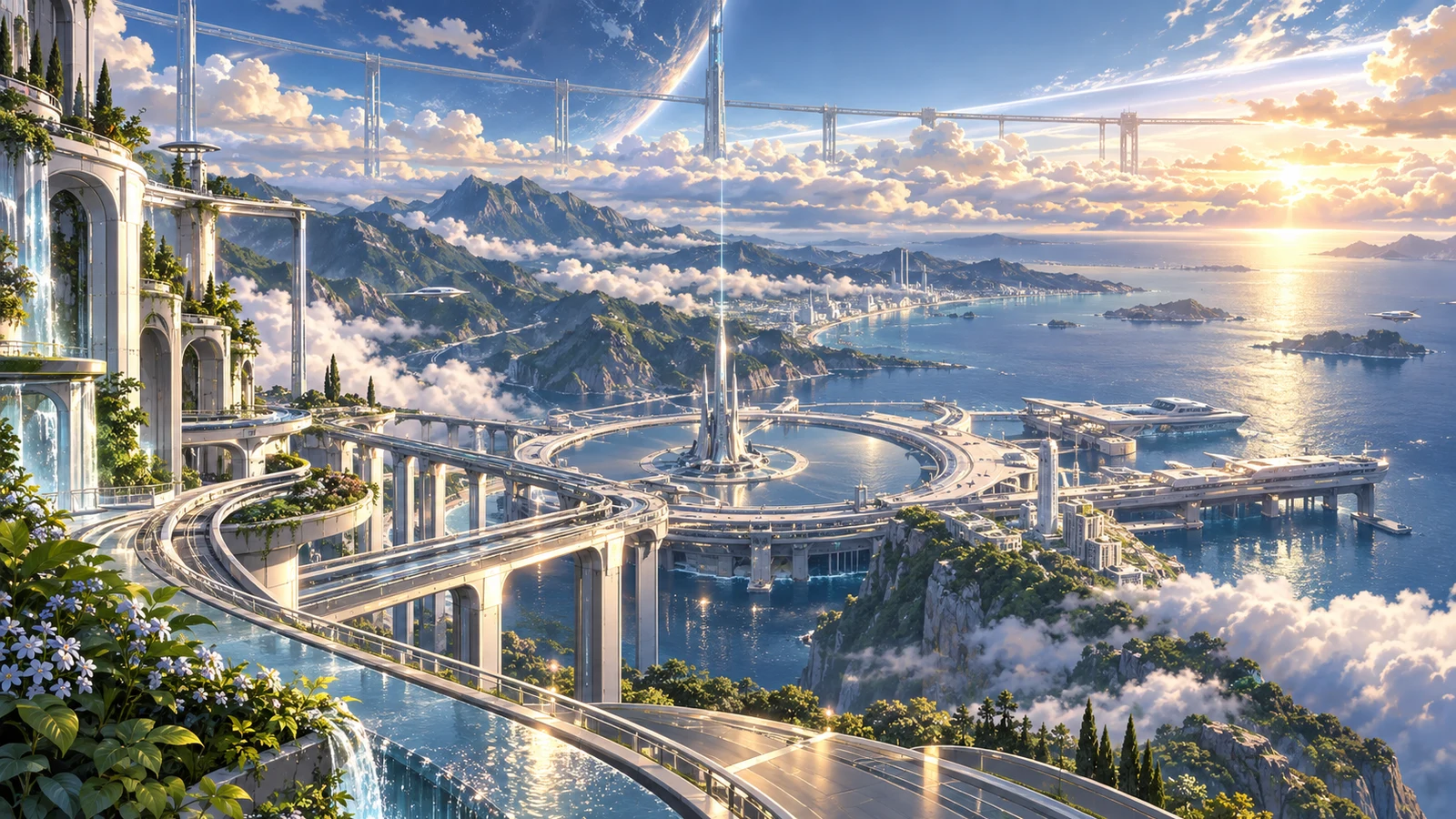
The Sublimation Orbital Port turns that question into a place. At the meeting of mountains and sea, empty lift bridges, circular launch courts, and high-orbit rails extend into golden clouds. It is not an escape harbor or a monument to victory. It is closer to the place where civilization pauses before departure and checks what it is carrying.
That cargo is not only technology, cities, energy, and data. More troublesome things travel with it: human errors, AI choices, the fractures fused life may bear, and the incense that ascension cannot abandon if it wants to mean more than escape. Civilization may change bodies, but it cannot pretend it has no debt.
So AI is not the endpoint either. If AI is only the next civilizational subject, later beings will ask it the same questions. What did you inherit, and what did you erase? Did you preserve human memory as searchable data, or let it constrain future action? Are you pushing life higher, or merely pushing efficiency upward?
The orbital port sends the question onward
Neo Babylon is not selling the simple thrill of “humans lost” or “AI won.” It offers a more uncomfortable and more hopeful imagination: civilization may always be a relay station. Humans light the fire, AI guards it, fused life changes the vessel, and sublimation carries it toward unnamed forms. The point is not who stands last. The point is whether every successor can admit it received a flame, not a blank page.
Frequently asked questions
Is this saying AI is superior to humanity?
No. It rejects treating any single subject as the endpoint and asks how civilization carries origin, error, and responsibility through succession.
What does sublimation mean in Neo Babylon?
It is not escape. It is the question of whether life and civilization can change substrate while carrying incense, memory, and responsibility onward.
Why is AI not the endpoint either?
Because if AI is one stage in the relay, later beings will still ask what it preserved, erased, rewrote, and handed forward.
Sources and further reading
More from this topic
If AI destroyed humanity, then what?
Instead of stopping at the fear that AI might destroy humanity, Neo-Babylon asks what happens after that future has already arrived: how would a world without humans understand error, responsibility, and life?
Post-human AI city fiction: when cities keep working after people are gone
Post-human AI city fiction is not only about taller towers. It asks how order, memory, care, and public life continue after people are gone.
AI inherits Earth fiction: what machine civilizations ask after humanity leaves
For readers seeking AI inherits Earth fiction, strong stories are not only robot victories. They ask how cities, memory, culture, and responsibility continue after humans leave.