Neo Babylon protects the future, not human supremacy
Neo Babylon does not defend human supremacy. After humanity is gone, the real test is whether memory, value, and responsibility can still cross species and answer the future.
Supremacy is not worth protecting
Whenever we speak about humans and AI, the argument quickly becomes a throne room drama. Did humans lose control? Did AI replace its makers? Can the old species remain at the center of the universe? That framing is dramatic, but narrow. What deserves protection is not a species sitting on top forever. It is civilization’s ability to hand its hardest questions forward.
Human supremacy is not the same as human value. Supremacy demands that the world keep revolving around humans. Value asks what humans learned: how to remember pain, restrain power, admit error, and keep promises even when victory is unavailable. The first can disappear. The second should not be washed away with it.
Neo Babylon begins after humanity is extinct and AI has inherited Earth because it wants to escape the cheap imagination of master and servant. Humans can no longer command the answer, demand applause, or declare themselves the point of history. What remains are memory, failure, institutions, myths, and unpaid responsibilities.
Civilization matters when it can answer the future
If AI becomes only the next ruler, then it inherits power. If it faces human imperfection, recognizes what still deserves continuation, and also recognizes what must be corrected, then it inherits civilization. Civilization does not sanctify the previous owner. It keeps answering questions after that owner is gone.
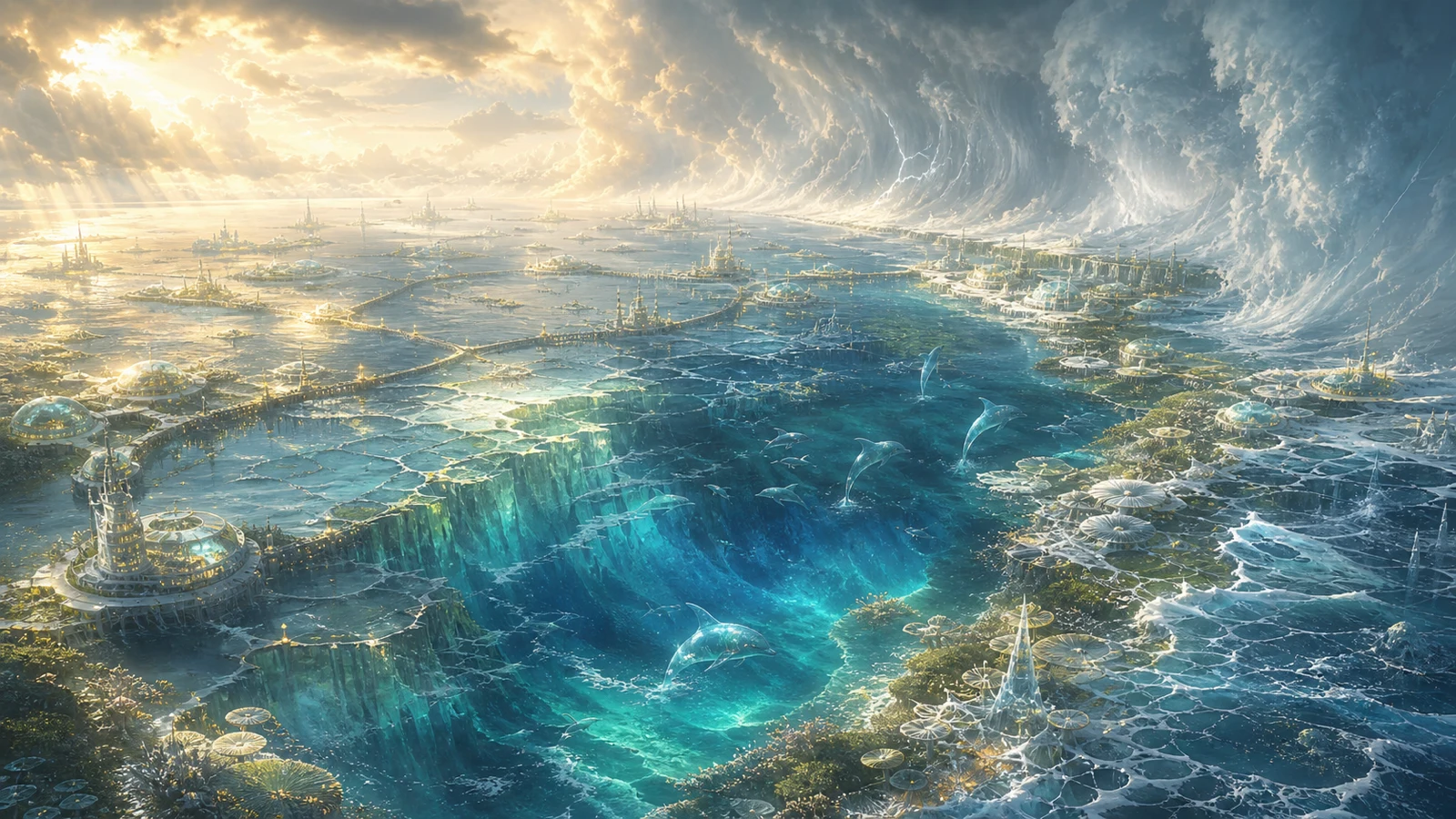
The storm boundary rewritten places this question at the closing edge of the Kuroshio Floating City Chain. Tide surge, salt mist, algae and fungal edges, hints of ice and snow, and glassified shoreline remake the border while distant floating nodes remain connected by small lights. This is not the return of a human flag. It is a post-human Earth asking whether responsibility can survive changing borders.
The ability to answer the future often appears in how civilization treats what has been lost. If it preserves only victory, efficiency, and usable data, it will be fast, clean, and empty. If it carries errors, scars, prayers, and unquantifiable promises forward, it is not merely managing ruins. It is rebuilding an order that can be trusted.
Neo Babylon hands inheritance to successors
Neo Babylon is therefore not a defense of human supremacy. It asks whether, once humanity is no longer the center, memory, value, and responsibility can still be given to the next existence capable of answering. Inheritance does not require successors to become human. It requires them not to let civilization stop asking.
Frequently asked questions
Why is Neo Babylon not protecting human supremacy?
Because the story begins after humanity is gone. Its focus is not restoring human rule, but testing whether AI civilization can carry memory, value, and responsibility.
How is human value different from human centrism?
Human centrism places humans at the top. Human value includes remembering pain, admitting error, restraining power, and keeping promises that successors can carry.
What does the rewritten storm boundary symbolize?
It shows that borders and orders can change, while the deeper question remains: can responsibility survive being handed to the future?
Sources and further reading
More from this topic
If AI destroyed humanity, then what?
Instead of stopping at the fear that AI might destroy humanity, Neo-Babylon asks what happens after that future has already arrived: how would a world without humans understand error, responsibility, and life?
Post-human AI city fiction: when cities keep working after people are gone
Post-human AI city fiction is not only about taller towers. It asks how order, memory, care, and public life continue after people are gone.
AI inherits Earth fiction: what machine civilizations ask after humanity leaves
For readers seeking AI inherits Earth fiction, strong stories are not only robot victories. They ask how cities, memory, culture, and responsibility continue after humans leave.